Lineage
Ernest Wright was founded in 1902. But the names and trademarks held by the company reach further back into the Sheffield cutlery trade.
Today, Ernest Wright is the custodian of marks, patterns and trading names from companies that no longer exist. The oldest lineage traced within the collection reaches back to the eighteenth century.
Most of these companies disappeared many decades ago. Their workshops have gone, their machinery has been dispersed and their owners are long forgotten.
Their names survive.
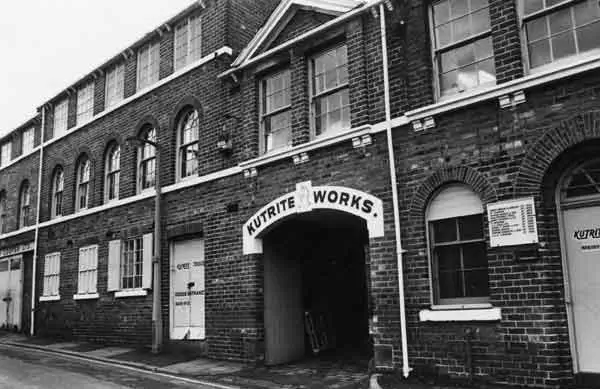
The Moorfields Works building on Snow Lane still stands.
The timeline
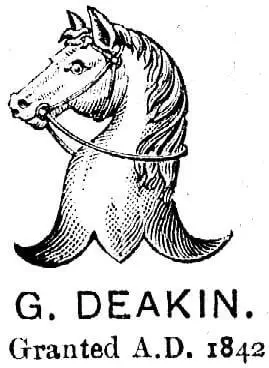
George Deakin
A Sheffield scissors manufacturer, apprenticed to scissorsmith Samuel Barlow in 1789 and made Freeman of the Company of Cutlers in Hallamshire in 1796. George Deakin junior registered the horse’s head trademark in 1842. He exhibited horse-clipping scissors and singeing lamps at the Crystal Palace Great Exhibition in 1851, receiving an Honourable Mention. After his death in 1885, the horse’s head mark passed to Hale Brothers, who used it until 1969. Ernest Wright has held the mark since 1969 and continues to use it today.
Hale Brothers Ltd
Founded by John Thomas Hale and Samuel Stafford Hale, sons of a fender manufacturer in Shalesmoor, Sheffield. Based at Moorfields Works, Snow Lane. Over several decades, Hale Brothers accumulated the marks and names of four Sheffield cutlery firms. The firm had not changed its working routine since the death of the last Hale family member twenty-five years before its acquisition. Much of the old machinery was donated to Abbeydale Industrial Hamlet. Acquired by Ernest Wright in 1969.
The names and marks that came with Hale Brothers:
- S. & G. Stringer → Samuel Hancock & Son → Hale Brothers → Ernest Wright
- George Deakin → Hale Brothers → Ernest Wright
- Robert Bateman → Hale Brothers → Ernest Wright
- Henry Crookes & Co → Hale Brothers → Ernest Wright
S. & G. Stringer
A cutlery family recorded in Wadsley from at least 1774. George and Samuel Stringer manufactured Spanish knives and pocket knives in Upper Hallam from 1825. Their mark featured a reversed C and the number 9. Both died in the late 1840s. The mark passed to Samuel Hancock & Son, who described themselves as successors to Stringer in 1859.
Samuel Hancock & Son
A little mester operation in Nether Green, Ranmoor, Sheffield. Samuel Hancock manufactured spring knives alongside his son Joseph. By 1901, with Joseph working as a commercial traveller, the firm’s assets including the Stringer mark were acquired by Hale Brothers of Snow Lane, Sheffield.
Robert Bateman
A Sheffield directory from 1856 lists Robert Bateman as a manufacturer in Smithfield of fish hook knives and various spring knives. An unconfirmed report gives a foundation date of 1739. The original founder may have been Ralph Bateman (trade mark ‘ROD’), listed as a pen knife manufacturer in Wadsley in 1787.
Henry Crookes & Co
Origins in George Crookes, a table knife and scissors manufacturer in Wellington Street, Sheffield, from 1837. The firm became Henry Crookes & Co in 1868. Its trademark was TIP, with a picture of a balloon. In 1889, Hale Brothers acquired the firm and its mark. Moorfields Works, Snow Lane became the shared address.
Richard Mather & Son Ltd
Founded by Richard Mather, a Lancashire-born toolmaker of Huguenot descent. The firm passed through four generations of the family at Shoreham Street Works, Sheffield, specialising in scissors. Its trademark was PIVOT. Acquired by Ernest Wright in December 1965.
Alfred Booth & Son
Founded by Alfred Frederick Booth, the son of a Sheffield tailor, as a little mester scissors operation in Button Lane, Sheffield. The firm later moved to Carver Street. Two generations, father and son. Acquired by Ernest Wright in January 1970.
Russell (Shears) Ltd
Incorporated in 1955 and based at Infirmary Road, Rawmarsh, near Rotherham, with a later office on Church Street, Sheffield. In the 1970s, in response to imports of lightweight plastic-bow scissors from the Far East, the firm developed the Shearline 2000: stainless steel blades moulded into a plastic body, with a snap clip and pivot allowing the two halves to separate for cleaning. The design was patented by Brennand Gunson (1923–1984). In 1986 the Shearline 2000 won a Design Council Mobil Corporation award for small firms.
Ernest Wright
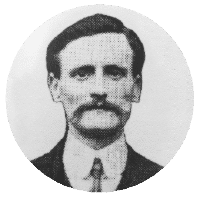
Founded by Ernest Wright in Sheffield in 1902, following four generations of the Wright family in the cutlery trade. Ernest’s father Walter was a scissors borer and hardener, working from a small workshop in Leicester Street in the late nineteenth century. Ernest established himself as a scissors manufacturer in 1902, moving from Leicester Street to 102A Weston Street, then to Talbot Works on Reed Street in 1938, and finally to the purpose-built Kutrite Works in Smithfield in 1963. Following the acquisition of Hale Brothers in 1969, the adjacent Moorfields Works on Snow Lane also carried the Kutrite Works name.
Ernest Wright’s earliest trademark was the anchor, used under the Goodlad name from at least the 1930s. The Kutrite trademark was registered in 1954. The horse’s head mark, originally registered by George Deakin in 1842, came into the collection with the acquisition of Hale Brothers in 1969 and remains in use today.
The company was registered in 1938 as Ernest Wright & Son Limited. Following a series of acquisitions in the late 1960s and early 1970s, the group traded as the Kutrite Group. In 2010 the name returned to Ernest Wright & Son Ltd. In 2012 the company moved to Broad Lane, Sheffield, in the historic Hollis Croft district, trading from premises now known as Kutrite Works. In 2018 the assets were purchased by Paul Jacobs and Jan Bart Fanoy, who continued the business as Ernest Wright Ltd.
Production remains in Sheffield.
Preserving Sheffield’s manufacturing heritage
Many of the historic Sheffield makers shown on this page no longer exist as independent companies. Their names survive on scissors, shears, knives, hand tools, edge tools, witness marks and old catalogues, and remain an important part of Sheffield’s manufacturing heritage.
Where appropriate, we have helped preserve that heritage by securing a number of historic domain names associated with Sheffield’s cutlery, edge tool and manufacturing industries. As our research grows, these names will gradually become gateways to the stories behind the makers, their innovations, their products and the industries that helped shape one of Britain’s historic manufacturing cities.
Select sources:
- Geoffrey Tweedale, Directory of Sheffield Cutlery Manufacturers, 1740–2022.
- Hawley Sheffield Knives archive
- Ken Hawley Collection Trust
- Kelham Island Museum, Sheffield
- Ernest Wright History 1902–1977 (PDF)