
Historical garment-making can reanimate the past – but it takes rigour and skill to elevate the clothing beyond fancy dress and towards authentic reproduction.
“It always starts with research, whether I’m making something for television, reenactments, a museum piece or anything else,” says Ninya Mikhaila of The Tudor Tailor.
“Everything that’s on show, whether it’s inside or outside, is done by hand, and there are quite a lot of processes in period dress that you can only do in this way,” she adds.
“There’s a lot of hand sewing involved, and most of the garments are made of more than one layer so that they’re lined, if not also interlined. It’s not exactly like modern tailoring.”
The making of a maker
If you’re interested in historical garment-making (or cultural heritage more broadly), there’s a good chance you’re already familiar with Mikhaila’s work. Her reconstructions of period dress have appeared in the BBC series A Stitch In Time, on the big screen in the 2022 film The Lost King, and in exhibitions for institutions including the National Trust, English Heritage and the Royal Armouries. A fascination with the past has underpinned every detail.
“The one subject I enjoyed at school was history – whenever my teacher spoke about the Wars of the Roses, Henry VIII and his six wives, and all of that, I was absolutely transfixed,” says Mikhaila.
“And then my mum has always sewn. She made clothes for me and my sister in the 1970s, and we stuck out like sore thumbs where we lived in East London,” she says.
“My family has a history of tailoring, and I recently discovered that this goes back further than I thought, as my great-great-grandfather was a tailor working in Glasgow. I have his certificate from when he was awarded the freedom of the city.”
Mikhaila resolved to follow in the family’s garment-making tradition – but with her own historical approach.
“What I wanted to do was to make museum-quality reconstructions, so after I graduated from the London College of Fashion in 1994, I started my business straightaway. I had an inherent belief that I would be able to make things.”


Old ways
When it comes to making a reconstruction fit for a museum – or indeed for a keen historical reenactor – the methods of modern garment-making often won’t cut it.
“There are very specific skills involved, including using canvas to shape aspects of the garment,” says Mikhaila.
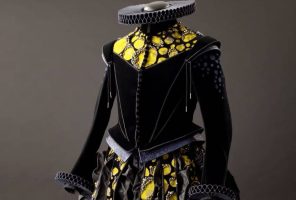
“I also do a lot of stiffening, especially when I’m recreating 16th century dress which requires stiffening and padding for both male and female garments.”
“Towards the end of that century the fashion for women’s bodies became very elongated and flattened, and so the stiffening needs to be there to achieve the look.”
Mikhaila is far from the only craftsperson practising historic techniques to faithfully recreate bygone fashions.
“There’s a community that’s grown out of reenactment and living history events, where craftspeople have evolved because reenactors have wanted the things that no longer exist,” she says.
“It started back in the ’70s when people used to just buy second-hand stuff and use things like old blankets, but now there are some really talented shoemakers and people that do other sorts of leatherwork and metalwork. They’ve revived their crafts.”
New interpretations
You might expect historical garment recreation to be frozen in time; a steady snapshot of the past. In fact, the field is constantly evolving, as new findings – including those of Mikhaila and her The Tudor Tailor co-founder, Jane Malcolm-Davies – continue to shed light on how our forebears really dressed.
“In any serious research you have to let go of things that you thought you knew in order to accept a new truth, and that happened to us quite a few times,” says Mikhaila.
“Think of the ‘bog bodies’ that have been buried in the earth. When they are found, somebody is revealed with their clothes – and because we have so few examples to go on, the new discovery can very easily change everything you thought you knew. It’s disconcerting and exciting at the same time.”
The Tudor Tailor’s recent research has focused on ordinary folk in Tudor times, whose clothing was relatively little documented.
“It’s much, much harder to find that information than it is for those of the elite, because ordinary people didn’t have their portraits painted and they weren’t necessarily writing things down in the same way,” she says.
“To get enough of a picture, you have to do a lot of detective work and gather the little snippets and fragments of information that are scattered through the source material.”


The power of reconstruction
While the past – that of the bog bodies, the Tudors, or even ourselves – grows more distant every second, reconstruction has the potential to bring it closer in physical fact. With every historical finding (or advancement in its application) comes a slightly purer echo of how we were and how we dressed.
“It is quite powerful – both the making experience and the wearing experience,” says Mikhaila.
“You can’t help but make connections with people in the past, whether they’re real or imagined. When I make these reconstructions, I feel connected to the people who have always made clothes in the same ways.”
All those who love heritage and history may recognise Mikhaila’s experience – that spark of shared humanity that leaps between Now and Then when we hold ourselves close to the past. It’s a feeling beyond recreation.
Photography © Bernadette Banner and Brian Bell