Ancient knowledge, fine skills and clever machinery. A historic craft, on the cusp of extinction. Silk-weaving shares much in common with scissors-making.
Surprisingly strong and sumptuously shiny, silk has been used to make many all sorts of items – from bow strings and siege tents to paper, parachutes and fine garments.
It all comes from the same source: the silkworm. These are the larvae of the silk moth (Bombyx mori), which have been reared in China for nearly 7,000 years in a practice known as ‘sericulture’. Each cocoon can produce around 900 metres of a single thread (according to some estimates), which can be spun into silk yarn and woven into pieces of fabric.
Silk had found its way to England and Wales by Roman times, but the silk industry flourished more widely from the 17th century, when artisans (many of them Italian and Huguenot immigrants) set up shop in Britain. There were weavers of fine silks in Spitalfields, worsted-silk clothmakers in Norwich, and silk button producers in Macclesfield.
Whitchurch Silk Mill was a somewhat later addition to the British silk industry, having opened its doors in 1815. Today, it is one of only three sites where silk weaving still shimmers in this land.
A glossy glossary of silk weaving terms:
- Sericulture: the farming or rearing of silk moths to produce raw silk cocoons
- Throwing: the cleaning, twisting and winding of silk filaments to produce threads
- Weaving: the process of turning silk threads into silk fabrics
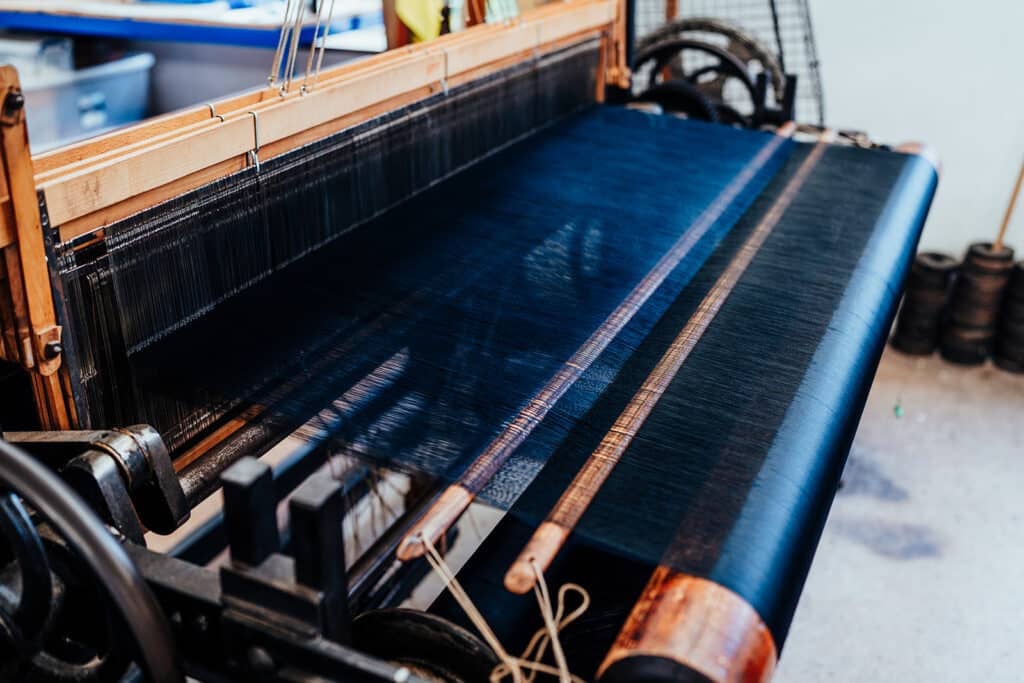
- Loom: a machine used to weave silk yarn into a piece of fabric
- Tackler: a person who performs maintenance on looms
- Warp: the threads running vertically in a piece of fabric
- Weft: the threads running horizontally in a piece of fabric
Britain’s last silk weavers
Like scissors-making, silk weaving is on the Heritage Crafts red list of endangered crafts. An estimated 21-50 Brits are employed in the craft, including a cluster of artisans at Whitchurch Silk Mill in Hampshire.
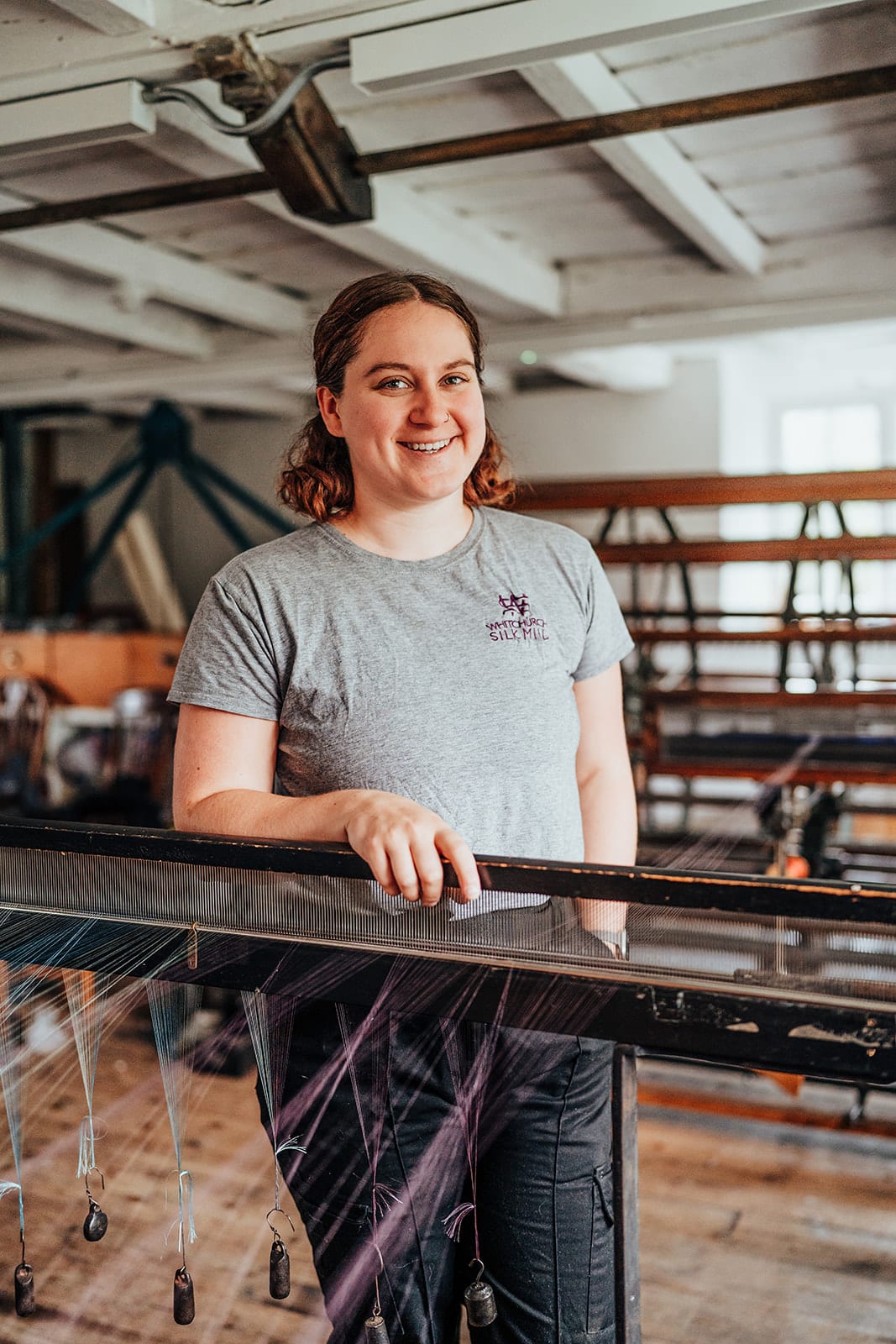
Here, Heritage Weaving Manager, Shannon Bye, acts as weaver and tackler – warping, winding, weaving, threading, and carrying out routine loom repairs. As a heritage-loving textiles graduate, she has clearly found the ideal craft.
“I’ve always loved the history of textiles as much as actually making them, so it was really nice to find this job with the perfect meld of the two: protecting heritage skills and machinery, making the silk and turning it into products at the other end,” Bye told Ernest Wright.
Silk ribbon weaving: a craft within a craft
Whitchurch Silk Mill specialises in silk ribbon weaving, a sub-craft with only a handful of practitioners in the UK.
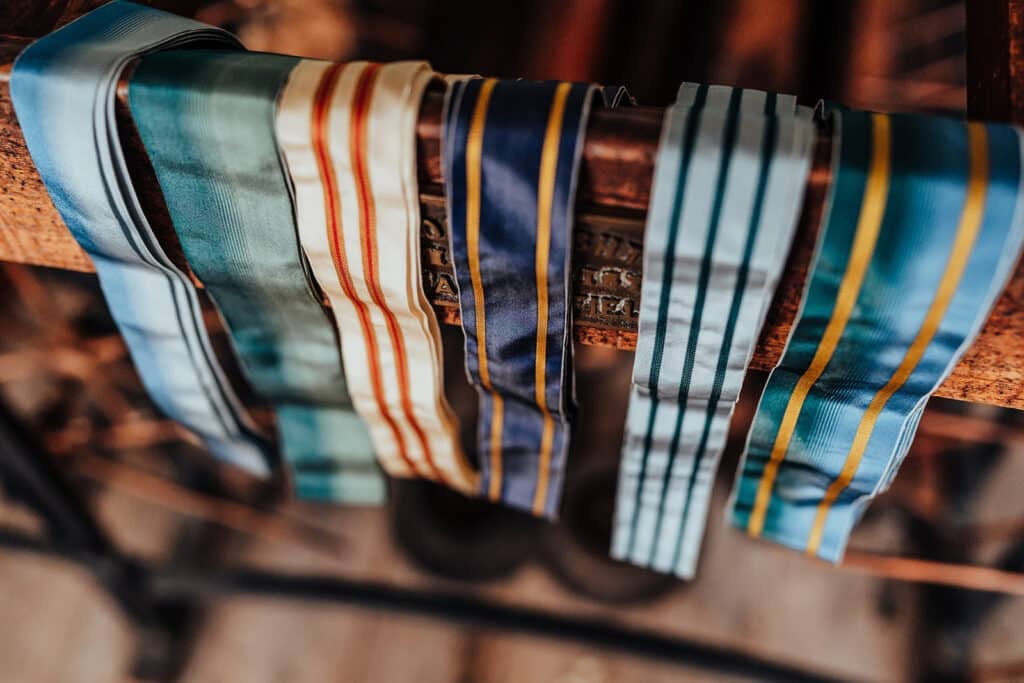
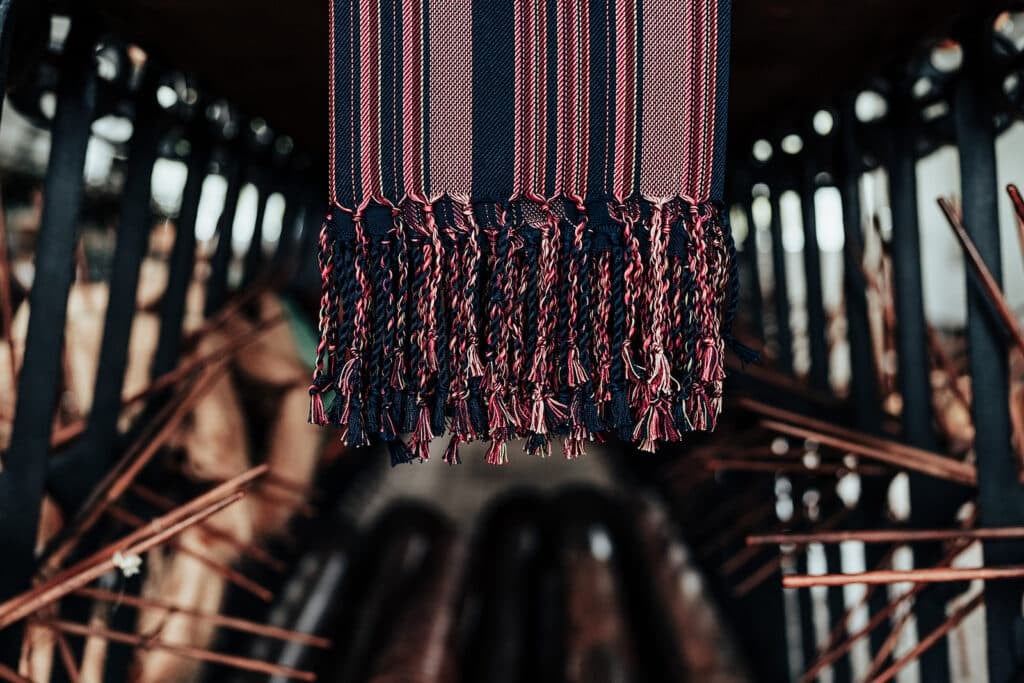
“It’s usually done with a ribbon loom, which weaves ribbons that are not much more than maybe three inches wide,” says Bye, “but we’re unusual in that we weave ours in a broadcloth, as a full width of about 14 ribbons with little gaps in between, and a special extra inserted warp yarn that gets twisted around the edges to create a tiny selvedge along each ribbon.
“This way we can weave a lot more in one go, but it does mean that we have to do a lot of trimming at the other end.”
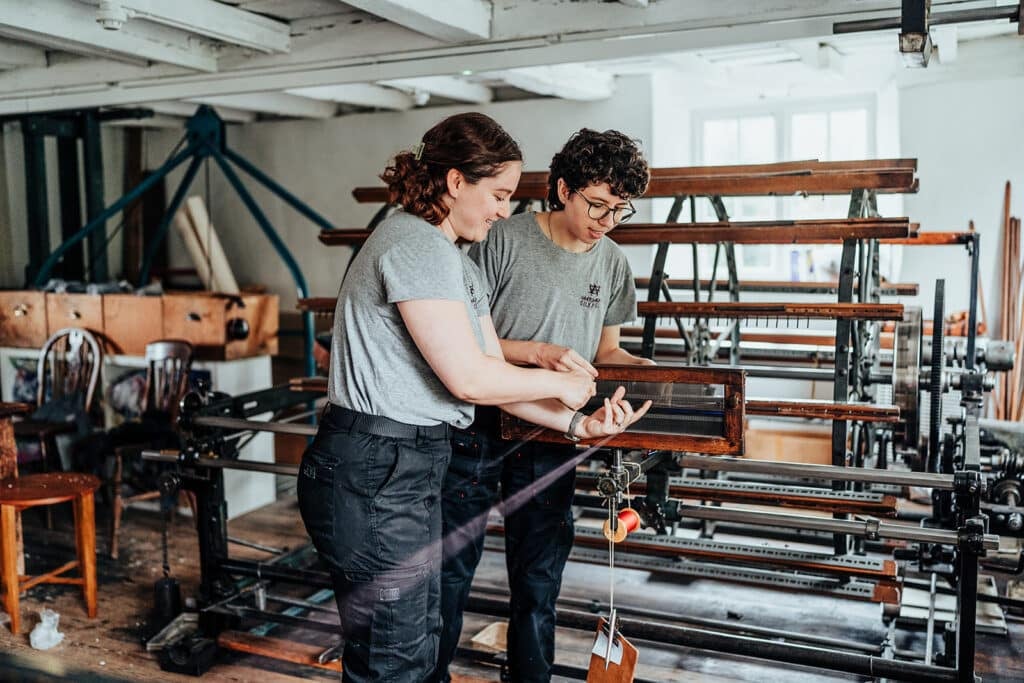
Without the work of Whitchurch Silk Mill, British silk ribbon weaving would be hanging by a thread. “There are five people in the country still doing it, and two of us are here, although our trainee, Bee, is nearly fully trained, and we’ll hopefully train another weaver after that,” says Bye.
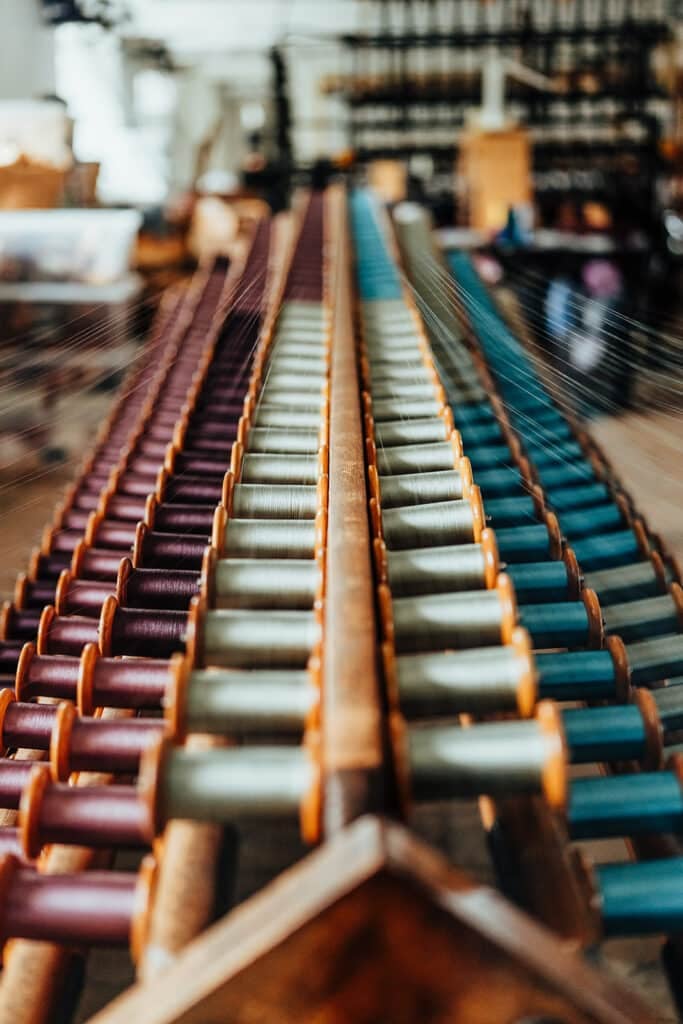
Warp and weft, weave and cut
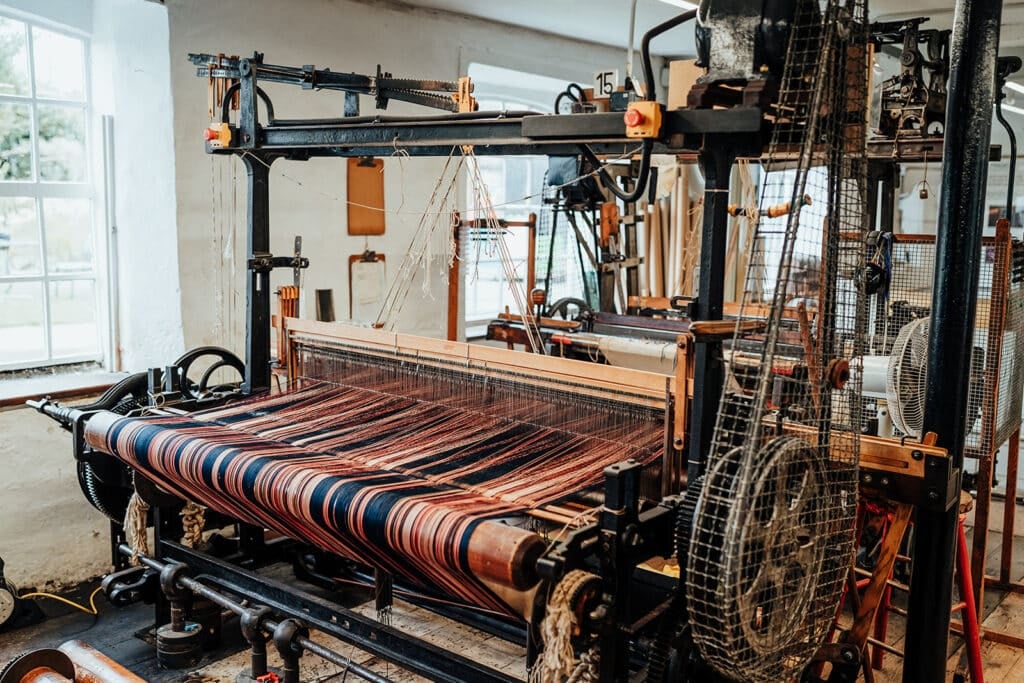
Much of Whitchurch Silk Mill’s weaving work is focused around its looms, which are of the ‘tappet’ and ‘dobby’ varieties.
“Dobby looms work like a reverse punchcard, with little pegs that push up and tell different knives to lift different shafts that are holding the warp threads,” says Bye, while “a tappet loom works a bit like a CAM system, with a track inside and parts called followers that rise and fall depending on the order you put them in, to give you a particular pattern.” Both types lend themselves well to ribbon weaving and producing stripes.
Whitchurch Silk Mill’s working looms date back as far as the 1890s, and some of its historic display pieces are older still. Several other types of silk weaving machines have been used through history, including the most rudimentary spindles, industrial-era ‘Dutch engines’, and Jacquard machines, which Bye describes as “like an early computer,” using a dedicated shaft for every thread to weave a complicated pattern.
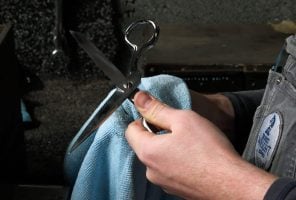
When the fabric for silk ribbons has been woven, it must be skilfully cut. The Whitchurch Silk Mill team needed a very sharp pair of scissors to start dividing their silk broadcloths into ribbons – and we’re proud to say that they chose an Ernest Wright pattern.
“Rather than snipping, I lay the cloth flat and glide the scissors through it, working in a teeny, eighth-of-an-inch gap,” says Bye.
“I’ve got to be really careful, because if I were to derail and catch the edge it would ruin the entire ribbon, and I’d have to cut across and make it shorter. The blades need to be sharp, because snagging would send them off-course.
“Once we’ve separated the ribbons from each other, they’re left with a sort of tufty tail on the edge, and we’ll use the scissors to snip it off,” she adds.
Still shining
While silk weaving has never exactly been commonplace in the UK, the industry was widespread in the 18th and 19th centuries, with hundreds of sites throughout the country. The first English factory was Thomas Lombe’s water-powered silk throwing mill in Derby, which opened in 1718.
Whitchurch Silk Mill was founded almost a century later. “At that time, the focus here was silk throwing, where you’re taking yarn from the silk moth cocoons, making it into thread and plying it,” says Bye. “A loom for weaving arrived around 1830, and a few decades later the mill was producing silk linings for Burberry trenchcoats.”
The mill has changed hands several times through the centuries. For a period starting in the 1970s it was owned by Ede & Ravenscroft, a traditional tailoring firm which used the facility to produce Ottoman silk for legal and academic gowns. (For more on this company, see our interview with Savile Row tailor, Ji Hae An.)
Since 1990, the factory has opened its doors to the public, as a museum showcasing the skills and practices of silk winding and weaving using traditional machinery.
A living craft
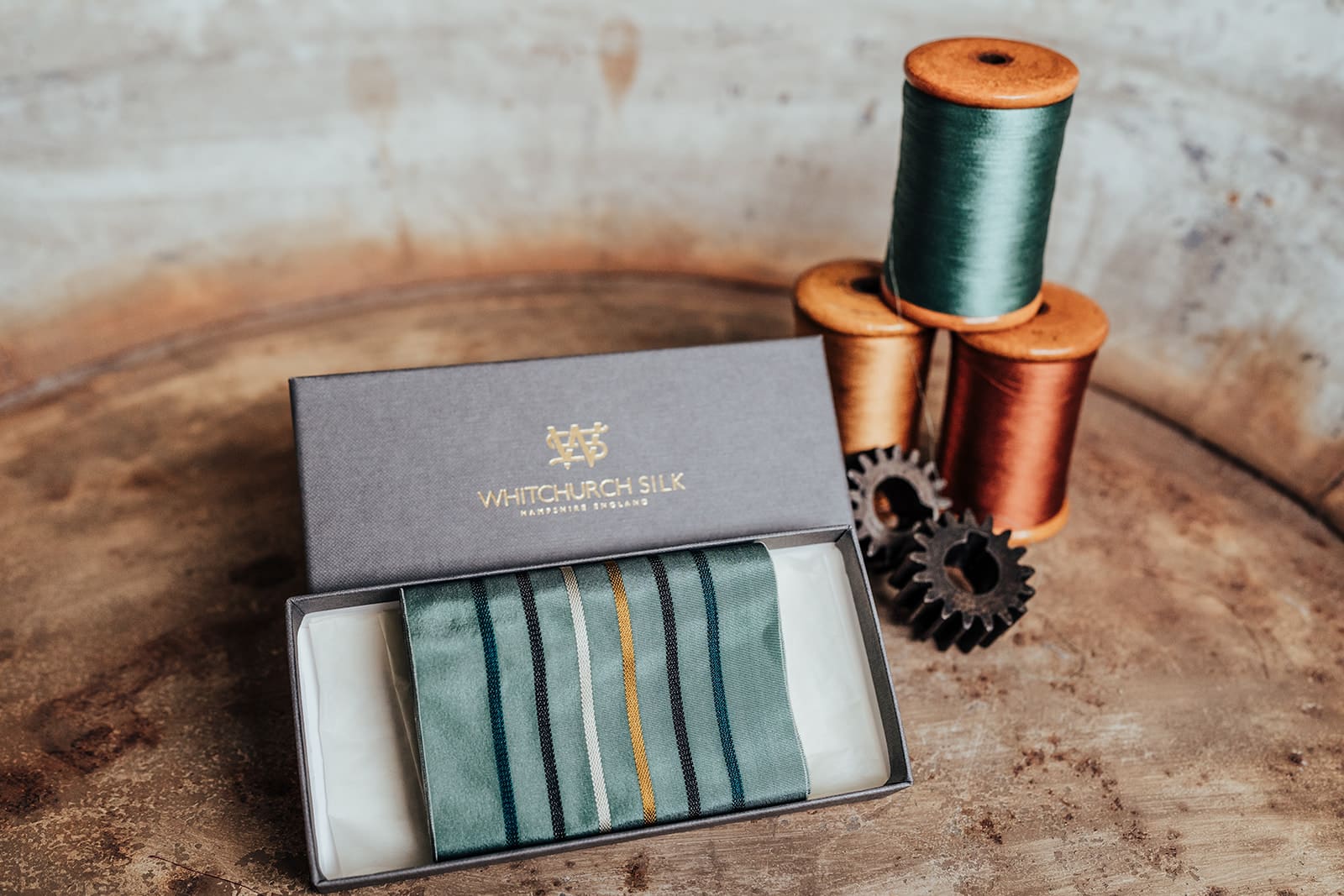
Whitchurch Silk Mill might be a heritage attraction, but it is still very much a working factory, producing sought-after textiles including shot silk taffetas, twills and, of course, silk ribbons.
Bye is particularly excited about a new collaboration with Jane Austen’s House, which marks the 250th anniversary of the author’s birth.
“Their team let us explore the house and its collection to get all sorts of inspiration for our ribbons,” she says. “We took that inspiration back, and used it to design the different colours and stripes in our ribbons. Some of the ribbons went back to the house, some stayed with us, and we’ve used them to make products like bookmarks and scrunchies.”
Another exciting project recently landed in Bye’s inbox: a commission from a New York tailor, Philip DePaola, for fabric to create a replica of George Washington’s inauguration suit. “The garment itself is over 200 years old, but the tailor got special permission to pick away at one pocket and work out the colour and weight of the fabric,” says Bye. “Because of the age of our looms, we can produce the closest fabric to the original.”
That’s a modest way of putting it. Whitchurch Silk Mill is a special place with extraordinary, antique machinery that’s kept running through an ongoing labour of love. But it’s the skills – Bye’s and her colleagues’ – that make those silks shine.
Whitchurch Silk Mill is open to visitors throughout the year, offering a rare opportunity to experience a living silk mill in operation.
All photography © Kirsty Bowen Photography