
Wherever people have worked, cleverly adapted workwear seems to have been developed alongside us. In the U.S., Levi Strauss pioneered the use of metal rivets to strengthen the pocketing on denim jeans, so workers could do tough jobs without fear of rips and tears. Earlier, in Ancient Greece, gloves were donned for protection during hands-on work such as gardening.
“I think everywhere has its version of chorewear, but the first to become ubiquitous, as far as I’m concerned, was French indigo,” says Pajotten’s Ben Sears.
Originally worn in 19th century factories, traditional French-style workwear now blends naturally into all sorts of contexts: art studio, workshop, home, office. It has a timeless practicality and aesthetic appeal – two elements that Ben brings charmingly into balance with Pajotten co-founder, Becca Barton.
Pajotten’s philosophy
At a studio in leafy Kent, Becca and Ben spend their days making a considered range of workwear staples: seersucker shirts, field dresses, trousers, chore jackets, overalls, accessories. The workflow appears simple: Ben cuts, Becca sews. Along the way, each partner puts their personality into the garments through numerous small, significant design decisions.
“We have a sort of perfect marriage between Becca, a very skilled fashionista and tutor, and myself, someone with a long history of working with tools, often in very clothes-specific contexts,” says Ben.
In practice, this often means Ben suggests various functional additions to a garment – before Becca decides which ideas to keep.
“I always wanted the clothes to be quiet, empty, and without fuss and nonsense,” says Becca. “I still try to keep with that, and Ben tries to keep with utility. We just hit in the middle, and it works.”


Practicality in details
For Pajotten, work-readiness is all in the detail.
“We want people to be able to wear the clothes every single day and for the clothes to perform – so we focus on things like pockets,” says Becca.
“Some pockets are really mean and you can’t even get your hand inside, so they’re completely useless. But when we do a pocket, we’ll always test it by putting things in it. Sometimes I think a pocket’s far too big – but once it’s on the garment it will work for that garment’s certain job,” she says.
Between Pajotten’s hard-wearing utility clothes and its lighter-weight ‘Constant Collection’, Becca and Ben aim to create long-lasting garments to fit all sorts of lifestyles.
“People can just find their garment, and it works all day, every day,” says Ben.
“I live in overalls. They’re not the most flattering – but they’re comfortable, I know where everything is, and I can change whatever I’ve got on underneath and then put them back on. They’re fantastic.”
Preserving workwear tradition
The cuts and colours used in Pajotten’s collections reflect the European workwear tradition. Many of their cloths are indigo, denim, tan or navy – although Becca does keep a swatch of neon pink fabric close to hand. (“I hide it in drawers because neon pink is my favourite colour, and I’m dealing with different shades for Pajotten,” she says.)
“One of the interesting things about European workwear is that it wasn’t engineered – it wasn’t made out of the denim and the heavy canvases that then required riveting and a lot of strengthening,” says Ben. “I think that came partially from the industrial revolution, but also from infantry uniforms because the military were always the ones that could mass-produce really sturdy clothing.”
Pajotten’s workwear is informed by diligent historical research – and visibly so. But that’s not to say the brand is backwards-looking. Becca and Ben take a ‘slow fashion’ approach to their business, with ethical sourcing, low cost-per-wear and hand-crafting at its heart.
“We’re a fashion brand, but our clothes last for years – much like the vintage French indigo workwear that’s 80 years old, and you can still buy and wear it,” says Becca.


Outfitting Ernest Wright
Ben and Becca’s historically informed, handmade approach to workwear made them a natural choice to make new uniforms for the putters at Ernest Wright. The pair kindly drove up to the workshop here in Sheffield, to show the team some options and take their measurements.
“Most of the putters chose Ben’s warehouse coat, which I made about five years ago, and they actually had four of those made,” says Becca.
“There were detailings added to that: things like the cuff. We normally do a cuff that you can just roll up, but they said no, actually, what we want is to have a button on it that’s very, very tight, so the cuff doesn’t get caught in the machinery,” she says.
Ben adds: “We came up with a couple of additional tiny details for Ernest Wright, including a little jigger button on the bottom corner of the coat that allows the flap to be buttoned back. The putters need to straddle bench grinders, so the jigger button lets them get their coattails out of the way.”
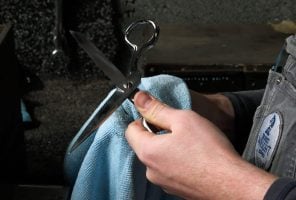
Practical and principled, Becca and Ben are a match made in workwear heaven. We like to think the same applies to Pajotten and Ernest Wright. Ben, it turns out, is a long-time user of our shears.
“I really needed to be able to buy a pair of scissors from the people who made them,” he says. “If anything should go wrong, I know where to send them – but coincidentally, nothing will go wrong because they are so well made.”
It’s incredibly satisfying to know that our own 13″ Classic Tailor shears, in expert hands, were used to cut the cloth to outfit our team. This is how craftspeople have always flourished together: in close collaboration, sharing common values, losing ourselves in work.