
Few activities are so closely bound together as sailing and the craft of sailmaking. A sailboat is powerless without its sails – and a sail only comes to life at sea.
“You create something that’s made of flat cloth, but it’s cut to produce a three-dimensional shape,” says Mark Shiner, traditional sailmaker. “Yes, you can temporarily hang the sail to see how it’s going to lie and check whether the curves are correct before you sew it up – but you don’t really see it till it’s out on the water.”
Every time a sail has unfurled and raised the curtain on a new chapter in exploration, naval history or daily coastal life, a sailmaker’s work has shaped the sailors’ fortunes. Shiner is among the last traditional craftspeople on these shores to transform two-dimensional plans and ocean charts into billowing sails and safe voyages.
“I’ve been sailing since childhood, and I got into sailmaking around 2002, when I was planning to build a dinghy,” he says. “An ‘encouraging’ friend had told me I couldn’t do it, but I got in touch with Margaret Crawford, an Orcadian sailmaker who was retiring, and she was happy to show me the ropes. It was great learning from someone whose motivation came from somewhere far deeper than raw commercial necessity.
“I got an industrial sewing machine via Freecycle, started doing repairs for local sailors and vessel owners, and it began to grow from there.”
Ten years later, Shiner and Crawford received some leftover funding from a local heritage project. They put the money into launching a sailmaking course – one of only two in the UK – which Shiner has since taught solo as Curriculum Leader for Maritime Studies at the University of the Highlands and Islands (UHI), Orkney.
Masters of the elements
As far as we know, the sail was invented before the wheel – and it has arguably done more to connect the globe. The earliest sailboats, including those used by the Ancient Egyptians, Carthaginians and Greeks, had only one mast with a single four-sided sail, but later vessels such as sloops and ketches often incorporated triangular sails, sometimes with multiple masts.
How the sailor trims a sail (adjusts its sheets while sailing) determines whether the wind propels the boat forwards, drives it sideways, turns it around or even heels it over. It’s the sailmaker’s responsibility – a matter of success or failure, and sometimes life or death – to ensure the sailor has the means to skilfully control their destiny.
Sailmakers were fairly widespread during the heyday of British seafaring. The 1841 census recorded 444 people with this occupation, from Aberdeenshire to Yorkshire. Many worked at sail lofts in coastal locations, although larger ships had their own sailmakers aboard. (Only one sailmaker was registered on Orkney in 1841: James Michael, who was then aged 60.)
“The sailmaking trade began to wind down in the late 1800s when steamboats began to come in,” says Shiner. “By then, sailmaking textbooks included instructions on how to make auxiliary sails for steamers. And then very abruptly, in the very late 1800s and early 1900s while there were still a few fishing smacks and other sailboats, sailing became posh, and sailmaking went into yacht racing.
“The vast majority of sailmakers now are making sails for yachts and recreational boats, and if you want to make a sail, you order a computer cut kit of panels to assemble yourself. There’s still a lot of skill involved, but it’s a lot more scientific,” he says.
What Shiner practises and teaches is the art of creating sails using hand skills, and without computer-aided design. “You’re making precise, aerodynamic shapes, much like a wing or an aerofoil, using old-fashioned rules, percentages, sums, and ways of orientating the cloth,” he says.
“It’s this style of sailmaking that’s endangered.”
Draughting destinies
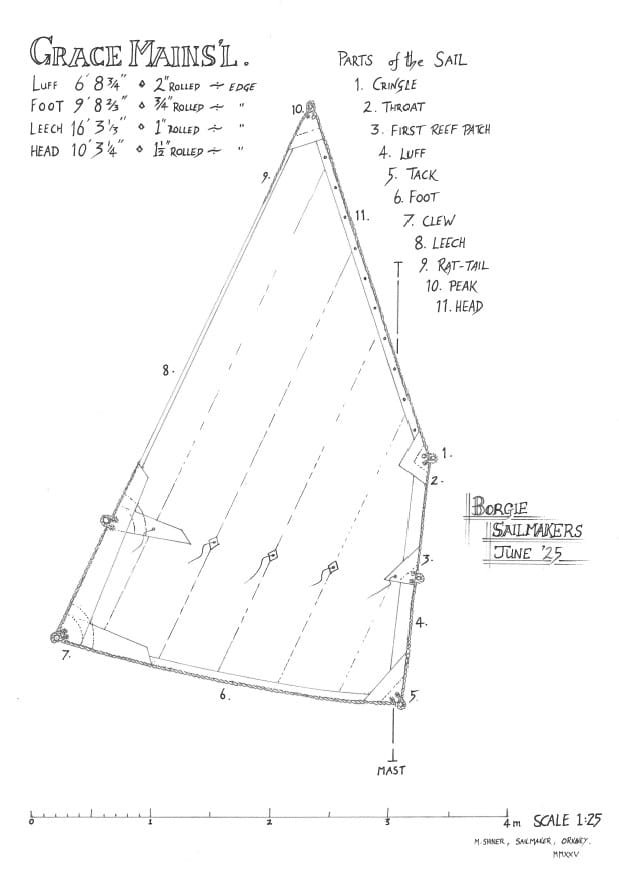
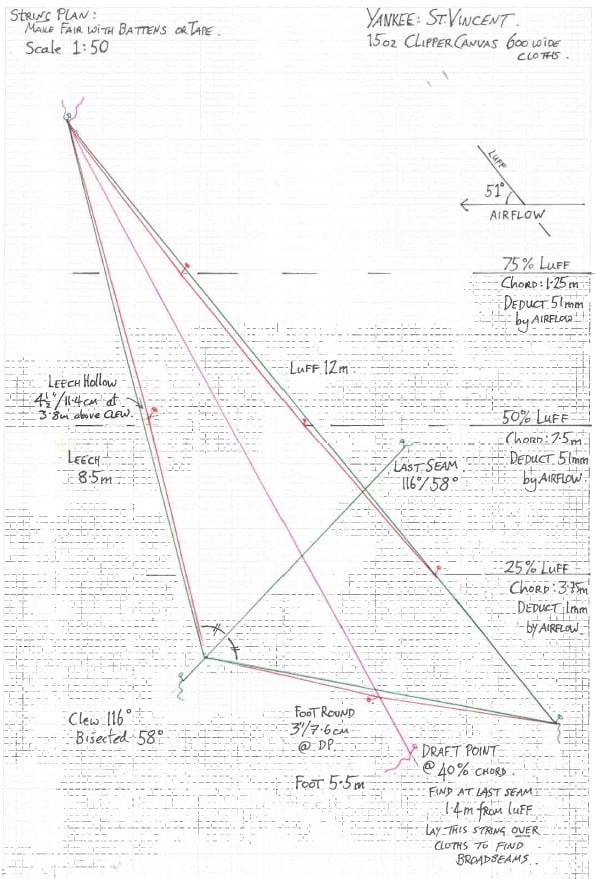
Sailmaking is inherently a bespoke craft, as the sails are always proportioned to fit parts of the boat, including the mast. The measurements must be just right, with some accommodations for stretching and the sailor’s preferences. “As a tailor keeps measurements, sail plans for individual sailors are diagrammatically recorded in documents,” Shiner notes.
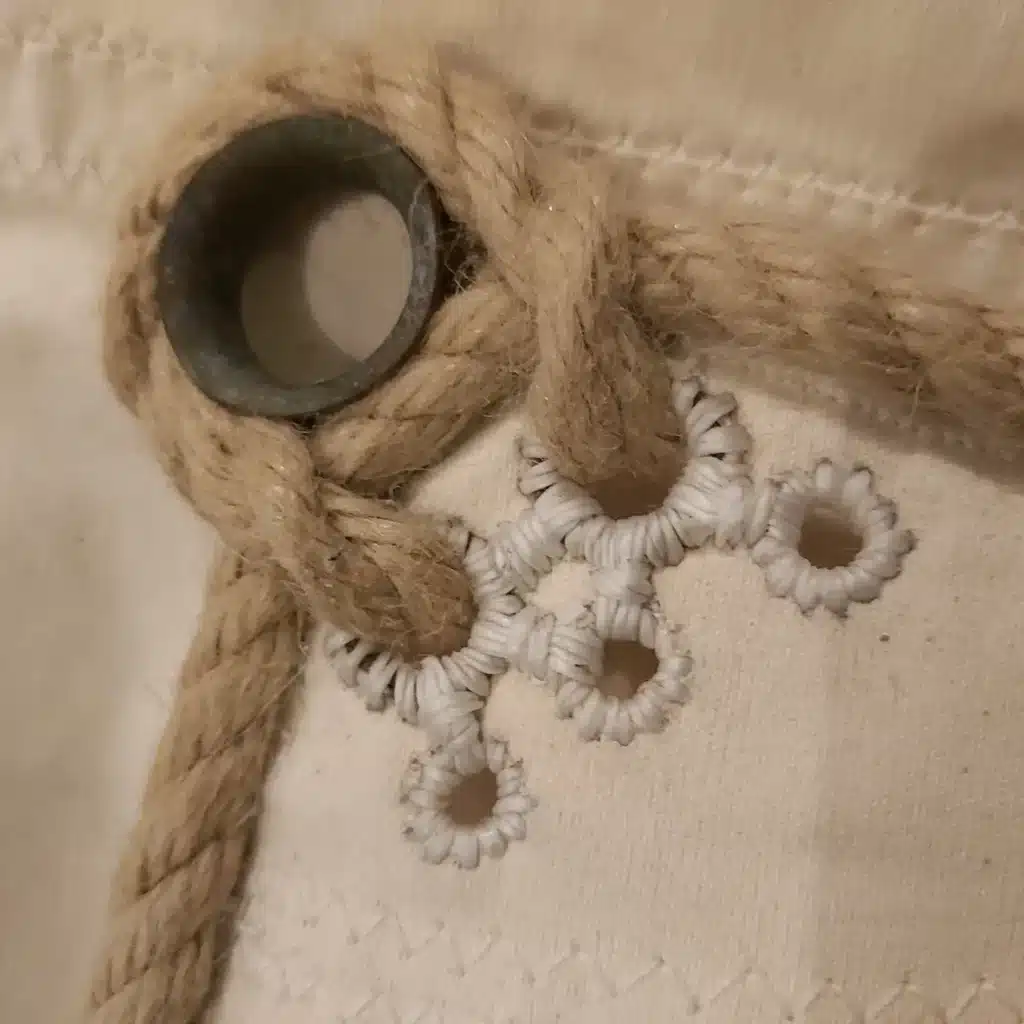
There are intricacies far beyond identifying the basic shape of each sail. For example, additional material must be included to allow the sail to stretch, and reinforced holes must be made in certain places to accommodate ropes that will be used to secure and manipulate the sail.
Complicated calculations are required to plan the sails for any boat. As Robert Kipping writes in his classic manual of 1847, The Elements of Sailmaking…, “Draughting presents difficulties to persons ignorant of it, which to the geometrician are easily summoned.” (A complete digitised version of this fascinating technical book is free to access via HathiTrust.)
Paper to sailcloth
Once Shiner has planned a sail, he brings it to life in sailcloth – which could be either traditional canvas or a synthetic fabric. “You can only use natural fibres if you’re always using the boat and looking after it, because the material will need constant maintenance,” he says. “If you had a yacht on the marina which you sailed every three or four weeks, you’d come back to find the sails all mouldy and mildewed.”
Each sail is made up of multiple pieces of sailcloth, which are sewn together using an industrial sewing machine. Connecting the pieces requires considerable focus – and plenty of floor space. “I’m very lucky that I’ve got room here in the Maritime Centre to make sails for small boats up to a hull length of about 24ft – and we can also use the local drama club rehearsal space to make larger sails,” says Shiner.
Special tools for fine handiwork
The fine work of finishing a sail is done largely by hand, with the exact steps depending on the type of sail – topsail, royal, cross-jack and so on.
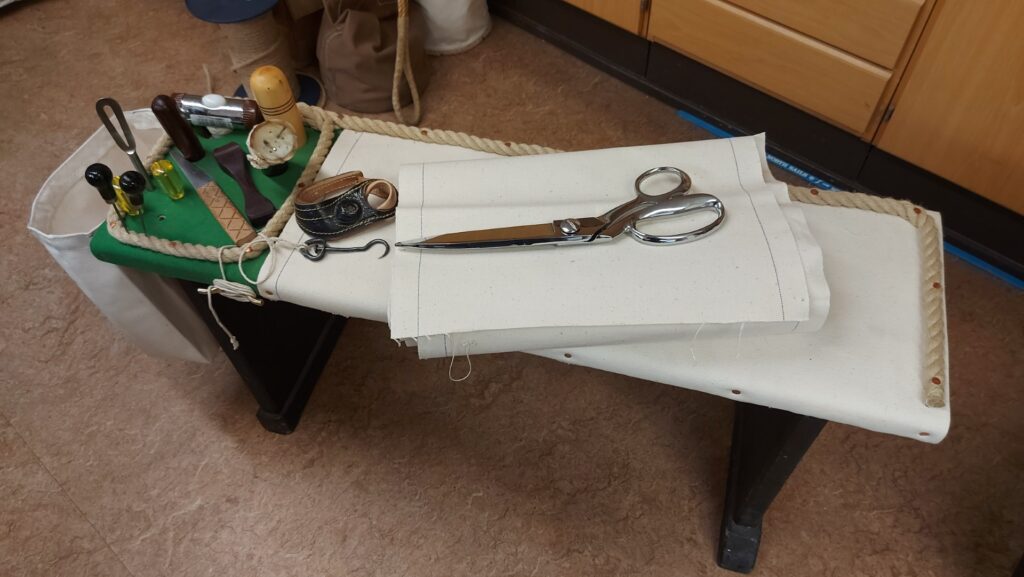
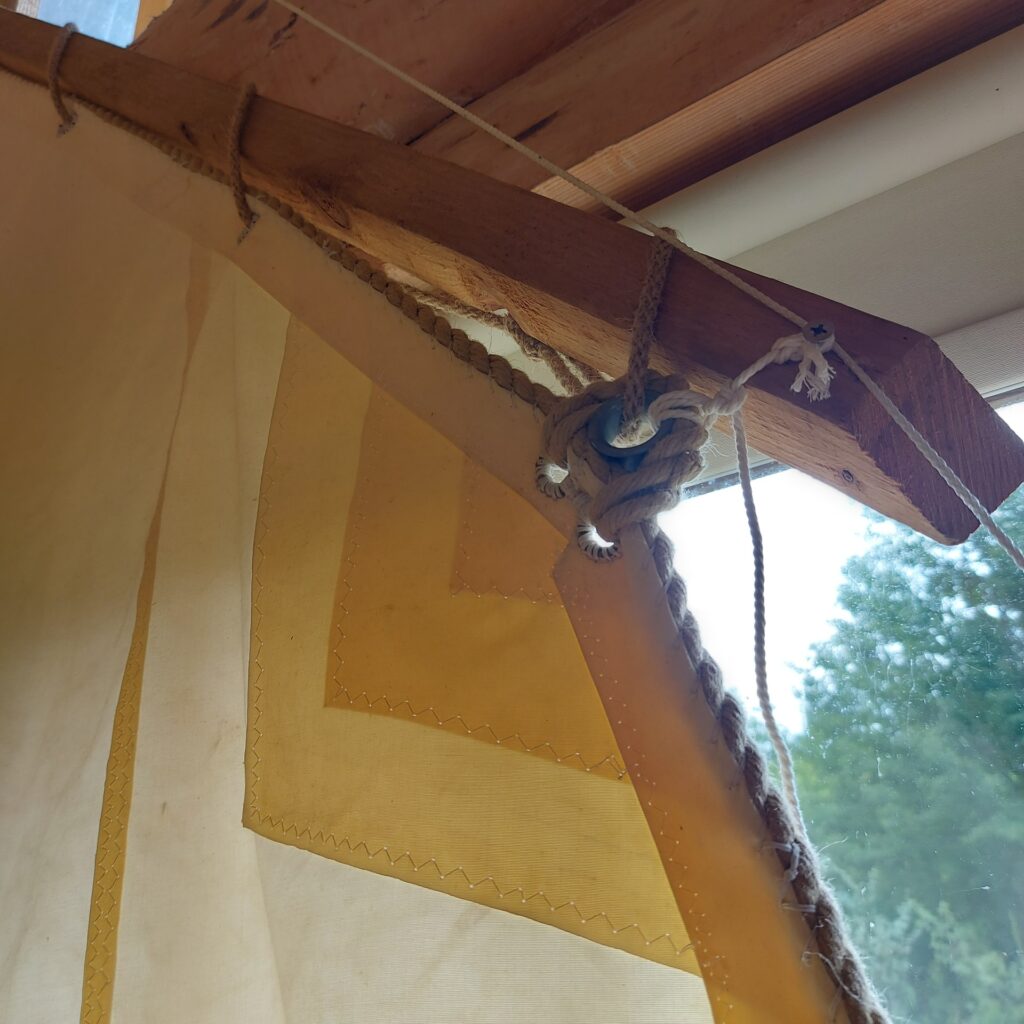
Sails are remarkably thick, especially where double flat seams form a layering of fabric at their edges. “To sew through heavy The canvas (or sew ropes around the edges of traditional sails), we use a hand tool called a sailmaker’s palm,” says Shiner. “It’s a leather pad with a metal disc set into it that sits over your hand, so when you’re sewing with a needle between finger and thumb, you put the heel of the needle against this pad and push with your arm to push the needle through. All this is done by hand – you can’t do it with a machine.
“We also use fids, made with wood or bone. They’re long, pointy spikes which you use to open the lay of rope for splicing it together or shaping an eyelet. I also recently put together a sailmaker’s sewing bench – if you look these up they are so individual, you really can’t get it wrong. The baize on the top keeps tools in place,” he adds.
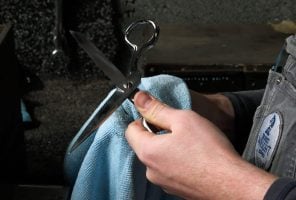
Shiner also uses shears in his sailmaking work – and we’re honoured to say that he has chosen a pair of Ernest Wright 12in Hardened Industrial Shears as his companion in craft. “Nowadays sailcloth comes in 150cm width, but I need to cut it down to 50cm so that there’s allowance for shaping and seams for stretching,” he says.
“You need some serious scissors to slit accurately up the sailcloth, and then when you’re cutting out on classic sails the corner reinforcements are often interesting shapes, so you’re doing an awful lot of cutting and the scissors are working very hard just to prepare the cloth,” he adds. “You tend to run the scissors along a line rather than snipping – unless you’re cutting something small. They get used on a wide variety of cloths, which is why the hardened industrial shears were the ones to use.”
Across the seas
Orkney has its own pearls of maritime culture – for example, a Norse-derived type of boat called the Orkney yole was traditionally used around these islands, and Orcadians have long been reputed as excellent rowers – but Shiner believes that the archipelago’s seafaring history has brought it closer to other coastal areas, rather than setting it apart.
“When we look at maritime culture from the golden age of sail, roughly from the mid-1700s to the mid-1800s, you’ll see that sailors were true internationalists, working alongside people of all races and creeds,” he says.
“Aboard the HMS Victory, at Trafalgar, there were plenty of people who were originally from India and the Caribbean – all sorts of folk working together, and they would have been completely integrated as a crew. National differences kind of got lost, because you would sail to some far-flung place and you’d adopt a knot that you saw at a port in Portugal, and then you’d try a splice that you saw in the Caribbean. It was a truly international community.”
Shiner’s teaching reflects this tradition of sharing knowledge and culture across the seas. Learners travel from far and wide to take part in his five-day sailmaking courses, before taking those old Orcadian, international skills back to their own corners of the world.
Fair winds
Like scissors-making, traditional sailmaking is endangered. Only 20 or so practitioners are working in this country, but the craft enjoyed a rare moment in the spotlight last year when Shiner won the UK and Scotland Maker of the Year awards at the Heritage Craft Awards 2025.
“That was quite unexpected, but it led to a couple of enquiries, which was brilliant,” says Shiner. “At the end of the day it’s all about protecting an endangered craft. I could just carry on doing what I’m doing, but I’d also love to take the skills out to other people.”
To that end, Shiner has been busy leading community sail-builds around the Scottish coast. “You load up a van with a sewing machine and other kit, you meet a group of people and you build a sail,” he says. “Recently, Strathnaver Museum on the very north coast of Scotland had built a beautiful little wooden fishing boat called Grace – she’s only about 14ft long – and they wanted a lug sail, so we built one in a hall, and they’re hopefully taking that boat to Lugger Fest, which is a traditional boat festival on the west coast.”
Shiner will share his skills through talks and activities at Lugger Fest, and he’s also been booked to speak at Washington state’s Port Townsend Wooden Boat Festival in September. And so the skills of sailmaking continue to wash from shore to shore, from Orkney to Ullapool, and even to the Pacific Coast of America. All the fuel they need to get there is knowledge, positivity – and fair winds.
Follow Mark Shiner on Instagram to learn more about sailmaking and maritime culture.